HubSpot & Visdum Integration: Automate Commissions via No- Code Integration
Q2 is ending in 7 days, RevOps is still exporting closed won deals from HubSpot, and Finance is importing everything into the master spreadsheet (again). Emails from sales reps are piling up in the finance team's inbox with no clear reply on when the commissions will post.
Two structural facts make it worse than it has to be. First, HubSpot does not calculate commission payouts, as its own sales commission glossary confirms.
Second, most legacy commission platforms were originally designed around Salesforce-centric workflows and enterprise CRM ecosystems. As a result, HubSpot often ends up being treated as just another integration rather than the system of record, leading to 8–12 week implementations, custom mapping work, and ongoing sync issues for HubSpot-based teams.
This guide covers why that gap exists, what breaks when teams build commission logic on top of HubSpot exports, how the HubSpot integration with Visdum closes it, and how to connect it in under 30 minutes.
The framework underneath the entire piece: HubSpot is the deal data layer. Visdum is the commission logic layer. Together, they produce a payout output with an audit trail your finance team can defend.
What is HubSpot, and What Does it Actually Own in the Revenue Stack?
HubSpot is a customer platform built around the deal object. For revenue teams, the relevant SKUs are:
Sales Hub is the system of record for deal-level data. It owns the pipeline. It does not own the payment logic. Treating HubSpot as both the deal source of truth and the commission calculation engine is the original mistake. Most spreadsheet-based commission processes start from that misclassification.
Why can HubSpot Not Calculate Sales Commissions Natively?
Three structural reasons.
- First, HubSpot is built around the deal object, not around plan logic. There is no concept of quota attainment percentage, tier escalators, SPIFFs, or role-based overrides beyond the basic deal split feature.
- Second, HubSpot has no concept of invoice payment. Companies that pay commission on cash collected, not closed-won, cannot model that workflow inside HubSpot.
- Third, HubSpot's reporting layer can run basic deal math, but it cannot version compensation plans, hold an audit trail of plan changes, or handle clawbacks when a deal amends post-close. If a deal goes from $144,000 to $108,000 in April after commission paid out in March, HubSpot will update the deal value. It will not chase down the overpayment.
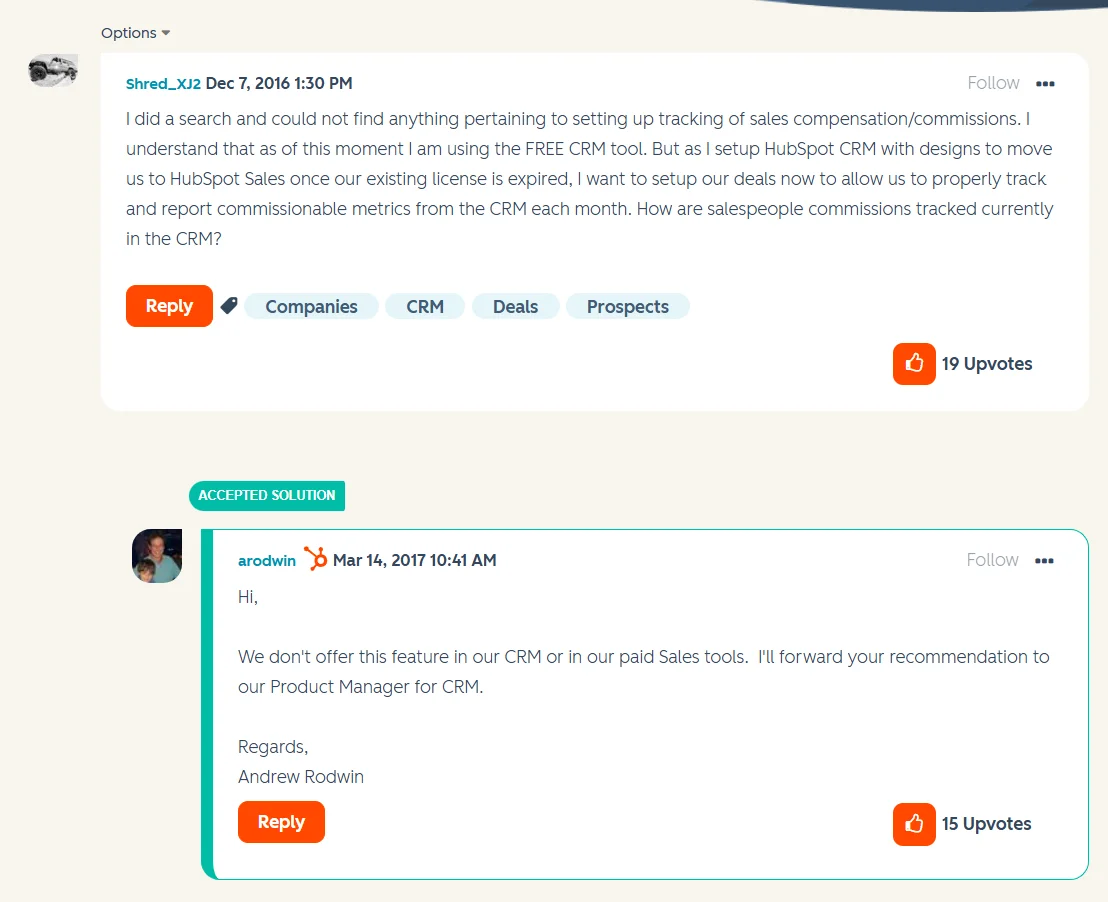
- HubSpot itself acknowledges this. The HubSpot glossary on sales commission states that HubSpot tracks deal information used as inputs for commission, but the payment calculation should be handled by a separate compensation system.
HubSpot Community threads from real Sales Hub customers echo this, with HubSpot product team confirming commission automation is not on the roadmap. That is not a gap HubSpot is hiding. It is the boundary of what a CRM is supposed to do. HubSpot was never built to give you a cutting-edge commission system. Visdum, on the other hand, was.
What Breaks When Commissions Run on HubSpot Exports ?
Three failure modes, ranked by frequency in customer onboarding conversations we have seen at Visdum
Deal-stage triggers do not equal paid revenue
The spreadsheet pays out when a HubSpot deal moves to closed-won. The deal cancels three weeks later. The rep already has commission accrued. Finance now owns a manual clawback process running on Slack messages.
Consequence:
- Real cash leaves the business against revenue that never lands. Commission expense gets restated across reporting periods, and ASC 606 amortization has to be reworked deal by deal.
- Recovery becomes a manual chase across Slack and email, sometimes after the rep has already left the company.
- Rep trust erodes every time a "final" payout number changes, and at scale a permanent gap opens between recognized commission expense and actual commissionable revenue.
No native commission logic means every plan change forces a formula rebuild
Moving from a flat 10% to a tiered structure adds IF statements, lookup tables, and version control. Add SPIFFs, accelerators, role overrides, and team quotas, and the formula breaks every quarter.
Consequence:
- Plan launches that should take days stretch into weeks of spreadsheet rebuilding, and reps lose visibility into how they will be paid in the exact window a comp refresh is meant to drive performance.
- The person who built the spreadsheet becomes a single point of failure, an undocumented bus-factor risk for the entire revenue org. Errors introduced during the rebuild (missed accelerator thresholds, broken lookups across tier tables, forgotten currency conversions) usually get caught weeks later by reps checking their own math.
- Forecasting commission expense for next quarter becomes guesswork, because the underlying model breaks every time it is touched.
HubSpot data drifts post-close, and historical exports break
Deal amounts adjust. Ownership changes after a rep leaves. Custom fields get renamed. The March export no longer matches the live HubSpot deal record by July.
Consequence:
- Auditors flag the gap between HubSpot deal records and commission payouts as a control deficiency in commission accounting, which can escalate to a material weakness finding if it recurs across reporting periods.
- ASC 606 amortization schedules built on drifted data need to be restated, affecting reported earnings and creating downstream tax exposure.
- True-up disputes that surface months later cannot be resolved against any single source of truth, and every audit cycle becomes a manual data archaeology project.
These are not edge cases. They are what HubSpot commission tracking looks like at every mid-market SaaS company that crossed 20 reps without replacing the spreadsheet. For a broader view of where CRM-driven commission processes structurally break, see Automated CRM Commission Tracking: Benefits and Myths.
How does the Visdum + HubSpot Integration Work?
Visdum sits on top of your CRM and uses its data as input. It does not replace HubSpot. It extends it to include the commission logic layer that was missing until now.
Visdum is a commission automation platform built to sit directly on top of CRM data. The integration with HubSpot Sales Hub connects Visdum to your deal, owner, deal split, line item, and pipeline data so that commission calculations happen automatically as deals close and progress through your revenue system.
The integration architecture follows a three-layer model:
Layer 1: HubSpot as the data source
Deals, close dates, deal amounts, deal owners, deal splits, line items, MRR fields, ARR, contract length, and custom property data live here. This is the input layer.
This is where Visdum's customization layer handles the parts that usually break commission integrations. During integration setup, Visdum walks you through a field mapping step where your HubSpot properties are matched directly to Visdum fields such as transaction ID, owner, close date, deal amount, and product line.
Any HubSpot property maps to a Visdum input: custom deal stages, bespoke product categories, modified ownership hierarchies, and HubSpot-specific custom properties for MRR, ARR, or contract length.
Where a HubSpot field has no clean Visdum equivalent, you can create a custom Visdum field to capture it directly, and that field becomes available to plan logic just like a standard one. The integration adapts to how your team already works in HubSpot, rather than forcing you to restructure your CRM around it.
Layer 2: Commission logic engine (Visdum)
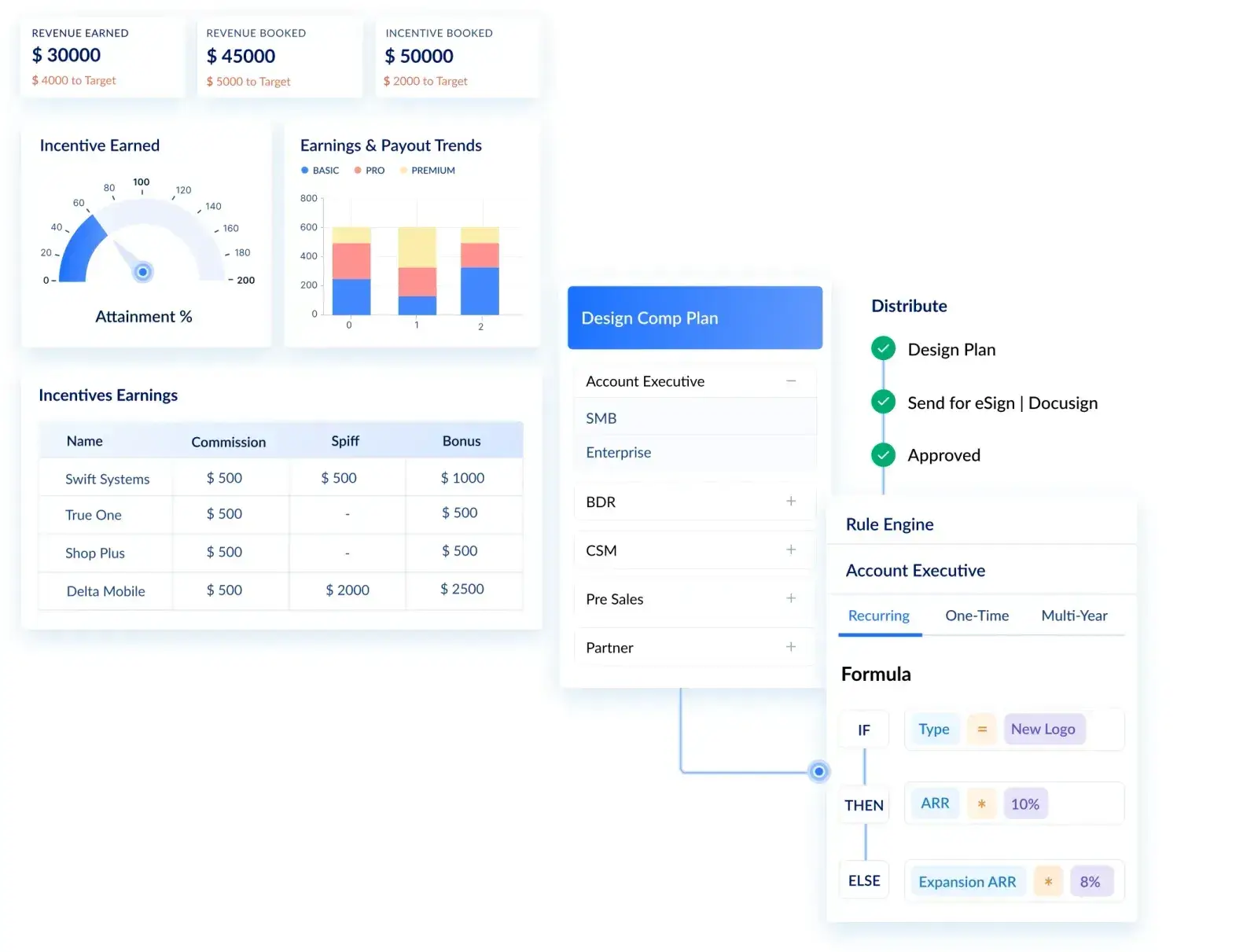
Compensation plan rules, crediting hierarchies, attainment tiers, accelerators, role-based splits, and clawback conditions are configured here. Visdum reads HubSpot deal data and applies these rules to calculate what each rep earns on each deal.
When a deal moves to closed-won in HubSpot, Visdum identifies the plan version in force at the close date, runs the calculation, and logs the result with a full audit trail tied to the HubSpot deal ID. If the deal amends or churns post-close, Visdum detects the change via the sync, recalculates against the new deal value, and flags a clawback for approval. No spreadsheet rebuilds, no manual chasing.
Plan configuration happens through Visdum's visual rule builder. No code, no formulas, no spreadsheet logic to maintain. If you can define your comp plan in plain language, you can build it in Visdum.
For a full walkthrough, this guide covers how to create a commission plan in Visdum in under 10 minutes. And if you want to see how the visual rule builder and dashboards work together, this overview covers both in detail.
Layer 3: Payout execution and reporting
Once calculations are approved, everything that follows is automated. Visdum integrates directly with payroll platforms, including ADP, Workday, and Deel, so payout data moves from commission calculation to payroll processing without anyone touching a spreadsheet. Payment goes out on the scheduled date, every time.
Commission statements can be sent for approvals and are also generated automatically and delivered directly to each rep's inbox. No rep has to ask finance where their number came from. No finance manager has to compile and send statements manually.
Visdum's AI Copilot takes this further. It lets Finance, RevOps, and Sales Ops ask natural-language questions and get instant answers on commission pay, incentive structures, quota assignments, and corrective actions, without digging through reports.
This architecture means your CRM does not change. Reps continue working in HubSpot Sales Hub the same way they always have.
Visdum reads the data and runs the compensation logic independently. The integration is no-code and HubSpot-certified.
What does the Visdum + HubSpot Integration Solve?
The table is the one-to-one translation from spreadsheet pain to Visdum capability. Each row maps to a process that either consumes RevOps and finance hours every month or runs automatically with an audit trail attached.
How Do You Connect HubSpot with Visdum?
The setup path is five steps. Most teams complete it in 30 to 60 minutes. No developer required.
Prefer a walkthrough instead? Watch this quick video tutorial for a complete step-by-step guide to integrating HubSpot with Visdum:
Step 1: Connect Hubspot to Visdum
Start by connecting your Hubspot account to Visdum. Go to the CRM integrations section in Visdum, select Hubspot, and click Connect.
.webp)
.webp)
Step 2: Create New Data Stream
Enter a stream name, select Earning as the stream type, and choose Hubspotunder Connected Apps as your data source.
Set preferences like deal credits and data sync, then click Next to proceed.
%20(1).webp)
Step 3: Map Your Data Fields
Map fields from Hubspot to Visdum fields like transaction ID, owner, date, and amount.Ensure each field is correctly aligned, then click Next to continue.
.webp)
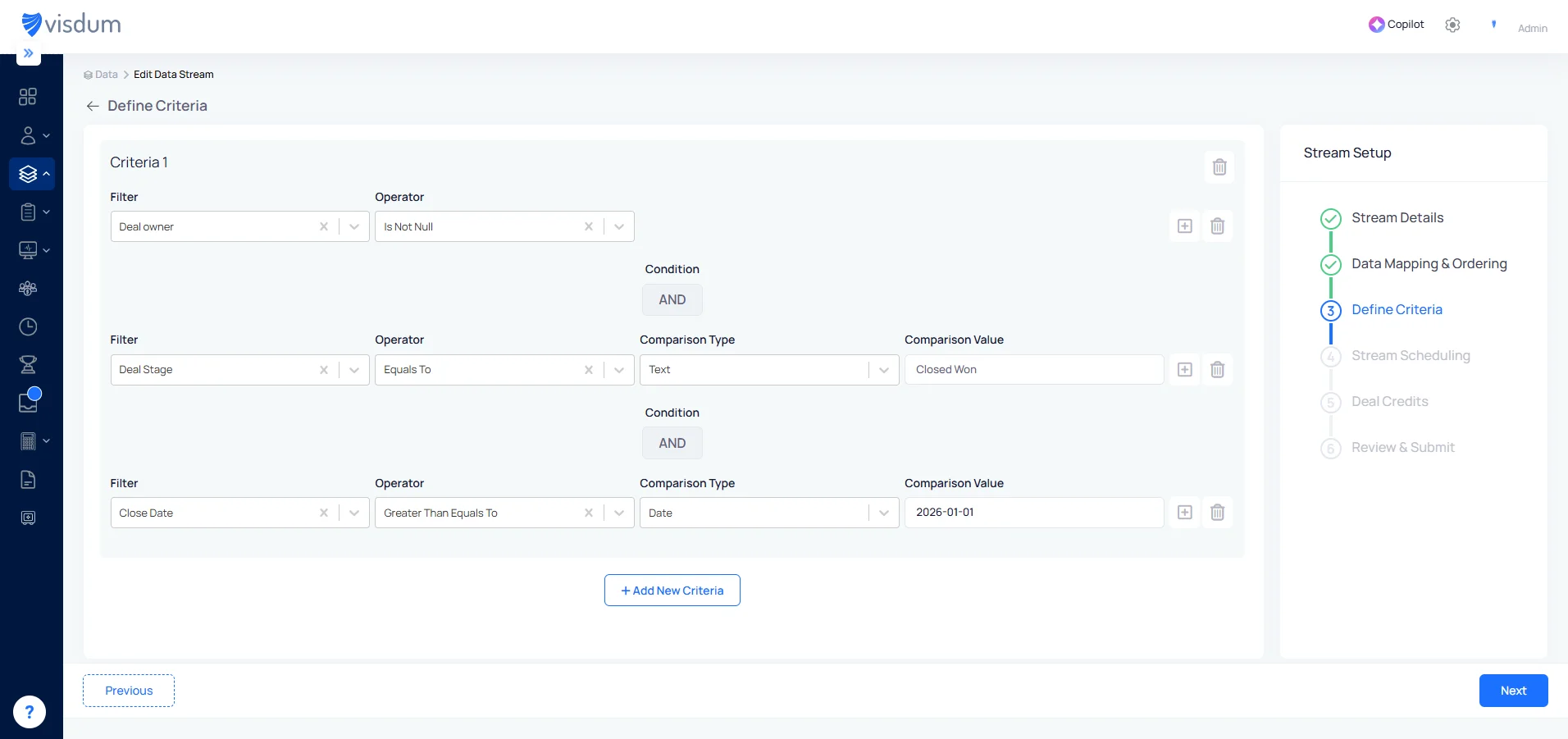
Step 4: Define Criteria
Set conditions like Deal Stage = Closed Won and apply filters such as close date or eligibility rules.This ensures only relevant deals from Hubspot are used for commission calculations.
Step 5: Schedule Data Sync
Select how frequently you want your data to sync by choosing days and time for the schedule.This ensures data from Hubspot is regularly updated for accurate commission calculations.
.webp)
Step 6: Assign Deal Credits
Define how revenue credit is assigned across contributors. Set rules for who gets credited, account owner, manager, or split across multiple roles, and at what percentage. Visdum applies these rules automatically to every transaction that meets your criteria.
.webp)
Step 6: Review & Submit
Review your data mapping, criteria, and schedule to ensure everything is correctly configured.Once verified, click Submit to activate the data stream and start syncing data from Hubspot.
.webp)
HubSpot alone vs HubSpot + Visdum: what changes for revenue teams?
How Does This Play Out For a HubSpot-Native Team at Scale?
Cyble, a cybersecurity SaaS company with 300+ employees and 70+ reps across the US, UAE, Singapore, Australia, and India, hit every structural HubSpot commission gap this guide describes.
Their setup: HubSpot for deal and pipeline management, QuickBooks and Zoho for invoice collection across different geographies. Their comp model: 8 different plans across Sales, PreSales, and Partner teams, with tier-based commissions paid on invoice collection rather than closed-won.
That last detail is the structural problem this entire guide is built around. HubSpot has no concept of invoice payment, so Cyble's finance team was manually stitching together deal data from HubSpot, collection data from QuickBooks and Zoho, and comp plan logic across spreadsheets for every payout cycle.
After moving to Visdum's HubSpot integration:
- 8+ data sets from HubSpot, QuickBooks, and Zoho automated with real-time sync
- 95% of finance team time saved on running commissions
- 100% payout accuracy achieved across all geographies and currencies
- Multi-currency conversion for reps in five countries handled natively
- A custom C-suite dashboard surfacing CAC, invoices collected, sales performance, and earnings in one view
The architectural pattern is the same one this guide describes: HubSpot stayed the deal data layer, Visdum became the commission logic layer, and downstream systems fed into a single audit-ready output.
.webp)
How Should HubSpot Teams Evaluate Commission Software?
For HubSpot teams evaluating commission software, three practical criteria matter more than feature lists:
- Time to go live - Can you launch in days, or does it take a quarter? HubSpot-native setups connect in under an hour. Most incumbents need 6 to 12 weeks of service-led implementation.
- Who can change a comp plan - A no-code builder lets RevOps adjust tiers, accelerators, and splits without external help. Older platforms route every plan change through a consultant.
- Whether the audit trail actually closes the loop - Every commission calculation should reconcile back to a specific deal ID, plan version, and approval timestamp. If reconstructing why a rep got paid takes more than 30 seconds, the platform has not closed the loop.
A controlled opinion that earns its place here: HubSpot teams should not pay enterprise pricing for software that does not treat HubSpot as a primary data source. The economics do not work for mid-market teams.
Visdum was built with HubSpot as a first-class data source:
- HubSpot-certified, listed on the HubSpot Marketplace
- Native sync across HubSpot-specific objects (deal splits, custom MRR fields, line items)
- No-code plan builder usable by business users
- 30 to 60 minutes to connect, no developer support needed
- Native multi-currency, plan-level configuration
.webp)
What does the RevOps and Finance Workflow Look Like After Integration?
Before integration, ownership is fragmented. RevOps owns the export. Finance owns the reconciliation. Sales owns the disputes. Nobody owns the source of truth, and every month-end is a negotiation between three spreadsheets.
After integration, ownership is clean. HubSpot owns the deal data. Visdum owns commission logic, approvals, and the audit trail. Sales sees real-time earnings. Finance gets clean payouts that reconcile to specific HubSpot deal IDs.
The measurable outcomes:
- Monthly close timelines compress by 4–7 days for teams replacing spreadsheets.
- Payout error rates drop to near zero, eliminating the largest source of rep disputes.
- Audit preparation time is reduced from weeks to hours.
- Dispute volume decreases as reps gain real-time visibility into deal-level commission breakdowns.
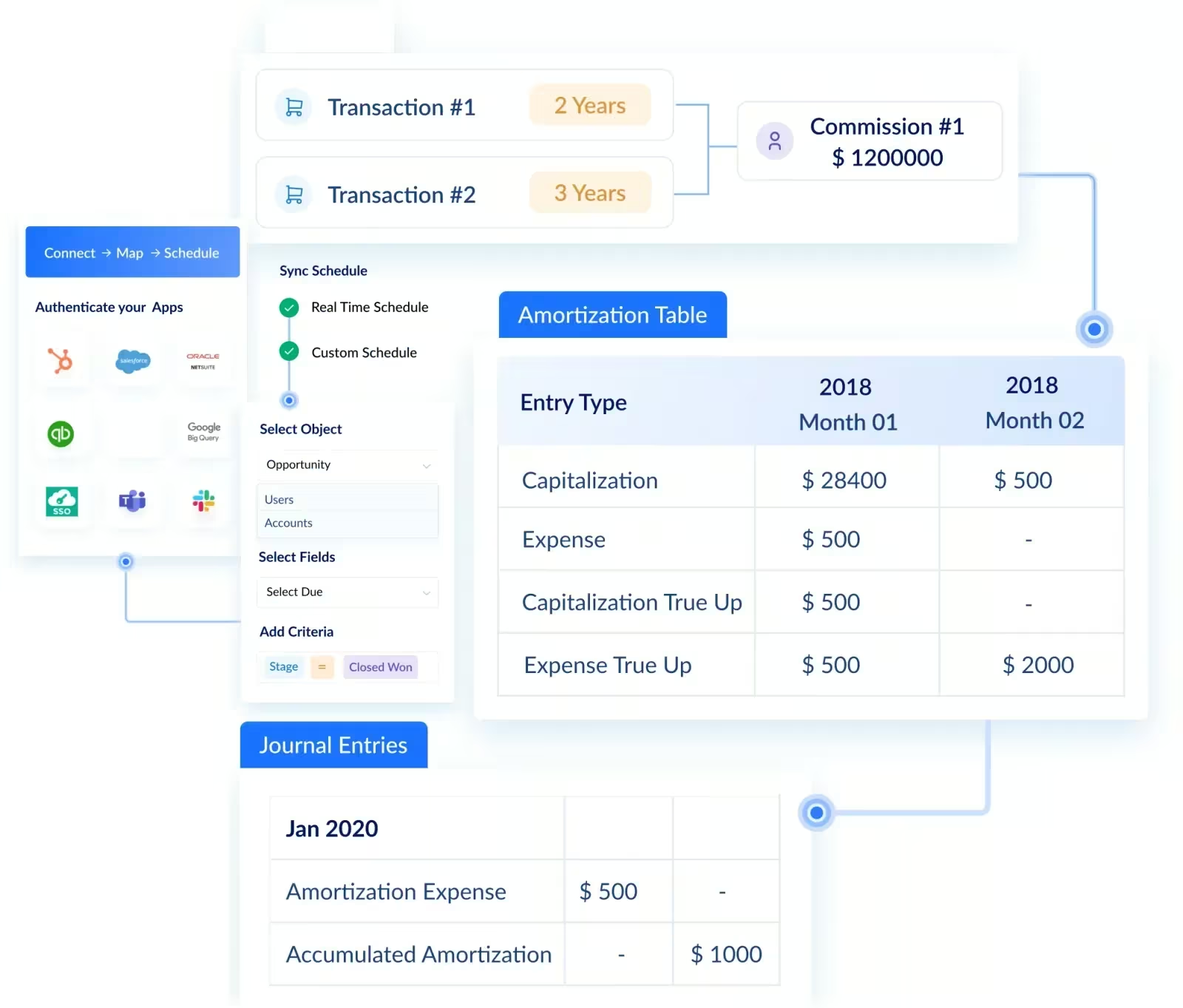
- Visdum supports ASC 606 amortization schedules and audit-ready reporting out of the box.
- Finance teams eliminate one of their biggest operational burdens after manual commission calculations.
For an operational example of these outcomes in practice, see how Sirion automated sales compensation to align with rapid expansion goals.
When Should Companies Automate HubSpot Commission Workflows?
The decision comes down to operational cost versus structural risk.
Operational cost: How many hours does your team spend each cycle on HubSpot CSV exports, formula rebuilds, deal-by-deal reconciliation, amendment chasing, and rep dispute follow-up? If the answer exceeds 10 hours for a team under 30 reps, the manual workflow already costs more than the integration.
Structural risk: Have you paid commission on a deal that later cancelled or downgraded? Missed a clawback because nobody noticed the HubSpot deal amendment? Reconciled a March payout against a July HubSpot record and found the numbers no longer match? Each incident costs 4 to 8 hours of finance time to resolve, plus unmeasurable trust erosion across the sales floor.
Clear automation signals:
Commission workflow complexity
- 15 to 20+ quota-carrying reps in HubSpot Sales Hub
- Multiple compensation plans across roles (AE, SDR, SE, partner manager), segments, or regions
- Plans change quarterly or more frequently
- Any commission structure with tiers, accelerators, role-based splits, or multi-rep crediting
- HubSpot deal splits that do not map cleanly to your comp plan logic
- Multi-currency teams running off the HubSpot deal currency field
HubSpot data and execution pain
- CSV exports from HubSpot require 30+ minutes of reformatting per cycle
- Custom properties (MRR, ARR, contract length) need manual reconciliation against deal records
- Month-end close delayed 2+ days waiting for commission reconciliation
- Deal amendments and churn events trigger manual clawback chases through Slack and email
- Rep disputes consume 2+ hours per pay cycle because HubSpot deal data has drifted since the export
- Plan launches take weeks because spreadsheet formulas need rebuilding from scratch
Compliance and audit exposure
- No clean audit trail from commission payout back to the source HubSpot deal ID
- Commission calculations maintained in spreadsheets with no version control
- Plan version in force at deal close cannot be reconstructed from records
- ASC 606 amortization schedules built manually outside the system of record
- At least one audit finding or compliance issue related to commission documentation
Conclusion
So, what is the bottom line for HubSpot-native revenue teams? The argument is structural, not technical.
HubSpot was not built to calculate commission. The commission platforms most teams default to were not built for HubSpot. Closing that gap removes the largest single operational risk in the revenue stack: delayed monthly closes, audit findings, and the slow erosion of rep trust that follows every payout dispute.
The framework holds. HubSpot is the deal data layer. Visdum is the commission logic layer. Together they produce a payout output your finance team can defend in an audit and your sales team can trust in a dispute.
If your commission process still lives in spreadsheets or on a platform that treats HubSpot as a secondary connector, the next step is not more research. It is a working demo against your real plan logic, your real deal stages, your real amendments.
.webp)
FAQs
What does Visdum offer that HubSpot alone does not?
HubSpot tracks deals, owners, splits, and pipeline stages. It does not calculate commission payouts, version comp plans, handle clawbacks on amended deals, or hold an audit trail of commission logic. Visdum adds the commission logic layer: automated calculations, plan versioning, role-based splits, accelerators, clawbacks, and ASC 606 amortization, all reconciled back to HubSpot deal IDs.
Can HubSpot calculate sales commissions natively?
No. HubSpot's own glossary confirms that the platform captures deal information used as commission inputs, but the actual payment calculation requires a separate compensation system. Sales Hub does not include tier escalators, accelerators, or plan-level role overrides.
How does Visdum sync with HubSpot deal data?
Visdum syncs bi-directionally with HubSpot via a certified API integration. The sync covers deal objects, owner records, deal splits, line items, custom properties, MRR and ARR fields, pipeline stage history, and amendment events. Updates flow in near real time.
How long does it take to set up the Visdum + HubSpot integration?
The integration itself takes 30 to 60 minutes for most teams. Standard plan configuration takes another 30 minutes inside the no-code builder. Complex multi-plan rollouts with change management typically take 2 to 4 weeks end to end.
Do I need technical or developer support to set this up?
No. The integration is no-code and built for business users. Anyone with admin access to HubSpot and Visdum can complete the setup. Visdum's customer success team provides onboarding assistance if needed.
Can I customize commission plans for different roles or teams?
Yes. Visdum supports role-based plans for AEs, SDRs, sales engineers, partner managers, customer success, and any other revenue-impacting role. Plans can be configured by deal size, product type, quota attainment, team goals, region, currency, and contract length.
Will Visdum automatically fetch deals from HubSpot?
Yes. Once the integration is live, Visdum continuously pulls closed-won deals and deal updates from HubSpot. No manual exports or uploads are required.
How often does Visdum sync with HubSpot?
Visdum syncs in near real time. Deal stage changes, value updates, owner reassignments, and custom property changes flow into Visdum within seconds. Sync frequency can be tuned to match specific workflow needs.
Does Visdum support multi-currency and international teams?
Yes. Visdum supports multi-currency configurations at the plan level. Different reps can be on different currencies and plan structures based on location or business unit. FX handling is native and audit-logged.
What happens if I change my commission structure mid-quarter?
Plan changes can be made anytime in Visdum. The system stores the previous plan version, applies the new plan from the effective date forward, and maintains full visibility into historical calculations. Reps can see which plan version applied to which deal.
What happens when a HubSpot deal is amended or churned after commission has paid out?
Visdum detects amendments and churn events via the HubSpot sync. The original calculation is preserved, the recalculation runs against the updated deal value, and the clawback is flagged for approval. The full audit trail captures every step.
Is the Visdum + HubSpot integration ASC 606 compliant?
Yes. Visdum supports capitalized commission tracking, amortization schedules, and audit-ready reporting that align with ASC 606 revenue recognition requirements.

.webp)